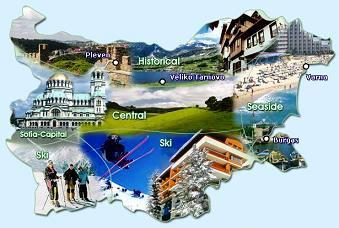
Territory: 111 000 sq. km.
Population: ~7 500 000
Capital city: Sofia ( 1,8 mil. inhabitants) The largest cities in the country are Sofia, Plovdiv, Varna, Burgas, Rousse, Stara Zagora.
Official language: Bulgarian, alphabet – Cyrillic
Administrative division: 28 regions, named after their respective regional centres.
State system: a parliamentary republic with a one-chamber parliament (National Assembly), consisting of 240 national representatives, elected for a four-year term of service. The head of state of the republic is the President, elected for a five-year term of service. The Council of Ministers is the main body of executive power.
Religion: Orthodox (85%), Muslim (8%), others (7%)
Time zone: GMT (London) + 2 hours, East-European time (Germany) + 1 hour
Location: in Southeastern Europe, occupies the central part of The Balkan peninsula.
Borders five countries: Romania to the north mostly along the Danube, Serbia and the Republic of Macedonia to the west, and Greece and Turkey to the south, as well as the Black Sea, which comprises its entire eastern border. Bulgaria has a scientific base on Livingston Island in the South Shetland Islands, Antarctica.
Landscape: diverse. The southwest of the country is mountainous with two alpine ranges – Rila and Pirin and further east are the lower but more extensive Rhodope Mountains. Rila mountain includes the highest peak of the Balkan Peninsula, peak Musala at 2,925 meters (9,596 ft); the long range of the Balkan mountains runs west-east through the middle of the country, north of the famous Rose Valley. Hilly country and plains are found in the southeast, along the Black Sea coast in the east, and along Bulgaria’s main river, the Danube in the north. Other major rivers include the Struma and the Maritsa river in the south. There are around 260 glacial lakes situated in Rila and Pirin, several large lakes on the Black Sea coast and more than 2,200 dam lakes. Mineral springs are in great abundance located mainly in the south-western and central parts of the country along the faults between the mountains
Climate: temperate, with cool, damp winters, very hot, dry summers; Alpine in Rila, Pirin and the Balkan Mountains to the mild and sunny along the Black Sea coast, from the typically continental in Danubian Plain (ancient Moesia) in the north to the strong Mediterranean influence in the valleys of Macedonia and the lowlands in the southernmost parts of Thrace. In summer, temperatures in the south of Bulgaria often exceed 40 degrees Celsius, but remain cooler by the coast.
Waters: rivers (main rivers are Danube, Maritsa, Mesta, Strouma, Iskar, Yantra); warm and cold mineral springs (more than 600); lakes ? coastal (some with curative mineral mud) and of glacial origin (in the Rila and Pirin mountains).
Plant and animal world: extremely diverse. An Act on the Protected Territories is operating in Bulgaria, aimed at the preservation of the country?s flora and fauna. It has specified the following categories in the country: a national and nature park, a reserve and a tended reserve, a natural sight, a protected locality.
Entrance in the country: Foreign citizens enter Bulgaria with their international passport, which shall be valid for at least three more months.
Custom’s formalities and limitations: Upon crossing the state border of the Republic of Bulgaria passengers may import and export commodities that in type, quantities, and value are not of a commercial nature. These do not include objects the passenger carry for personal use and consumption objects.
Passengers have the right to import at no custom duty or import fees the objects necessary to the foreign individuals for their stay in the country, which in their type and quantity correspond to both purpose and the duration of their stay, as well as consumption objects:
– tobacco products (passengers over 16 years of age) – cigarettes – 200 items, or other tobacco products – 250 gr.;
– alcoholic beverages (passengers over 16 years of age) – wine – 2 litres, and alcoholic liquors – 1 litre;
– other drinks: coffee – 500 g. or coffee extract – 200g. tea – 100 g. or tea extract – 40 g.;
– perfumes – 50 ml. and toilet water – 250 ml.
Passengers who are under full 16 years of age are not entitled to duty-free import of the commodities listed above, except for medications.
Electricity: 220 V, 50 Hz
Money exchange: The Bulgarian currancy is Levm which is devided in 100 stotinki. The Lev is pegged to the Euro. EUR 1 = BGN 1.95583 / USD 1 = BGN 1.38
You may exchange money in banks and in any of the numerous exchange offices. Some of those offices are opened during the holidays. Euro-checks may be cashed on a lot of banks. Do no exchange money in the street!!!
Credit cards: Most of the hotels work with VISA or Master Card. American Express is less widespread.
Taxi-cabs: In towns and resorts there are taxi-cabs situated in the respective taxi ranks.
Urban transport: In towns there is urban transport: buses and mini-buses. In Sofia there are trams, trolley busses and underground. Tickets are usually bought before getting on the vehicle.
Traveling by car: Since 01.01.2001 there are no entrance and transit fees for cars any more. However, there are vignettes applicable /EUR 34.00 per year, Eur 13 per month, EUR 5 per week, EUR 10 per day, all for every vihicle up to 8 seats/. The vignette should be labled down in the right corner of the frontwindow. Between November 1 and March 1, you have to drive with lights turned on.
Post offices and telecommunication: Working hours of post offices is from 8:00 a.m. to 6:00 p.m. Postage stamps and postcards may be bought from the desks in the post office or from pavilions selling newspapers. There are a lot of internet-cafes from which you may talk cheap or send e-mails (most of them work 24 hours).
Important phones:
Dialing code for Bulgaria from abroad +359
Emergency – 112
Fire-brigade – 160
First aid – 150
Police – 166
Road assistance 146
Telephone information – 144
Traffic police – car accidents +359 2/ 982 72 823, 866 50 60
Important web pages:
Airports in Bulgaria:
1. Sofia airport www.sofia-airport.bg
2. Varna airport www.varna-airport.bg
3. Bourgas airport www.bourgas-airport.com
4. Plovdiv airport www.plovdivairport.com
Sea and river ports in Bulgaria:
1. Sea port of Varna www.port-varna.bg
2. Sea port of Bourgas www.port-bourgas.com
3. River port of Rousse www.port-rousse.bg
4. River port of Lom www.port.lom.bg
5. River port of Vidin www.port-vd.com
Central railway station in Sofia www.bdz.creato.biz/bg/
Central bus station in Sofia www.centralnaavtogara.bg